How Gama Hospital Turned Its Crowded Lobby Into a 24/7 Multilingual AI Front Desk


A voice AI agent now greets patients the moment they walk into Gama Hospital, understands their symptoms in five languages, and points them to the right specialist and the right floor before they ever reach the reception desk.
The busiest desk in the hospital
Walk into almost any large hospital and the first thing you meet is a queue. Not a medical queue, an information queue: patients waiting to ask a receptionist which doctor treats their symptom, where the lab is, whether their report is ready, and what time the clinic opens.
For Gama Hospital, one of the leading private hospitals in Saudi Arabia's Eastern Province, that information queue had become a genuine operational bottleneck. So they did something most hospitals only talk about. They put an AI agent in the lobby, gave it a voice, taught it five languages, and let it take the questions before the front desk ever hears them. The hospital named it the Gama AI Smart Guide, and launched it in November 2025.
About Gama Hospital
Gama Hospital is a multi-specialty private hospital in Al Khobar, in Saudi Arabia's Eastern Province, and part of the Samir Group. It serves a patient base as multilingual as the Gulf itself: Arabic-speaking local patients alongside a large expatriate workforce from South Asia and beyond.
That mix is what makes a hospital lobby hard to run. On any given evening, the person at the front desk might need to move between Arabic, English, Hindi, Tamil and Malayalam, answer a clinical-sounding question they are not qualified to judge, and keep a line moving at the same time.
The champion behind the project
The Gama AI Smart Guide had a clear owner from day one: Shafi Syed, Gama Hospital's Director of Health Information Management and IT and a Certified Healthcare CIO (CHCIO). He led the search, ran the evaluation of four vendors (including two local providers and one international competitor), and chose Tars on the strength of the working demo. From there he scoped the deployment, shaped the knowledge the agent would run on, and drove it all the way to launch.
Before a single part of the agent was built, Shafi wrote the problem down plainly. Four issues, all pointing at the same desk:
- Reception overcrowding. Patients queued at the front desk for basic questions about treatment, doctors and appointments.
- Patients sent to the wrong specialist. Reception staff do not have the medical knowledge to route a symptom to the right physician, so patients were often redirected from one doctor to another.
- A call center that was always busy. Sixteen phone lines, frequently engaged, pushing the load straight back to the lobby.
- No guided patient journey. Nothing took a patient from "I have this symptom" to "this is the doctor I should see."
Underneath all four sat the language gap. When the receptionist on duty did not speak a patient's language, even a simple question about where to go became a struggle for both of them.
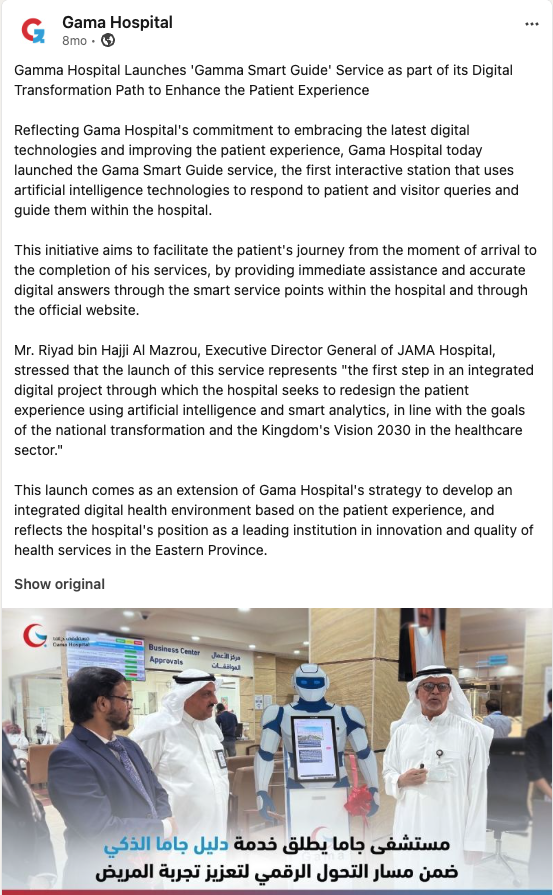
View the original post on LinkedIn.
The solution: a voice AI agent that works the lobby
Working with Shafi's team, Tars deployed the Gama AI Smart Guide as a voice-first AI agent running on tablets in the hospital lobby. A patient walks up, speaks their question in their own language, and the agent answers back, on screen and in voice. Three design choices made it fit the lobby rather than fight it.
It is voice-first, not a form. Patients do not type, they talk. That matters in a lobby where people are standing, carrying things, elderly, in discomfort, or not comfortable typing in a second language.
It is multilingual by default. The agent handles Arabic, English, Hindi, Tamil and Malayalam, and switches to the patient in front of it. The lobby now has a multilingual receptionist that answers even when the human staff on shift do not speak every one of those languages.
It triages, it does not just look things up. This is what separates it from a touchscreen FAQ. The agent takes a symptom and works out where the patient should actually go.
Here is what that looks like in the lobby: a single, voice-first conversation that moves between English and Arabic, listens through speech, speaks its answers back, and guides the patient to the right place.
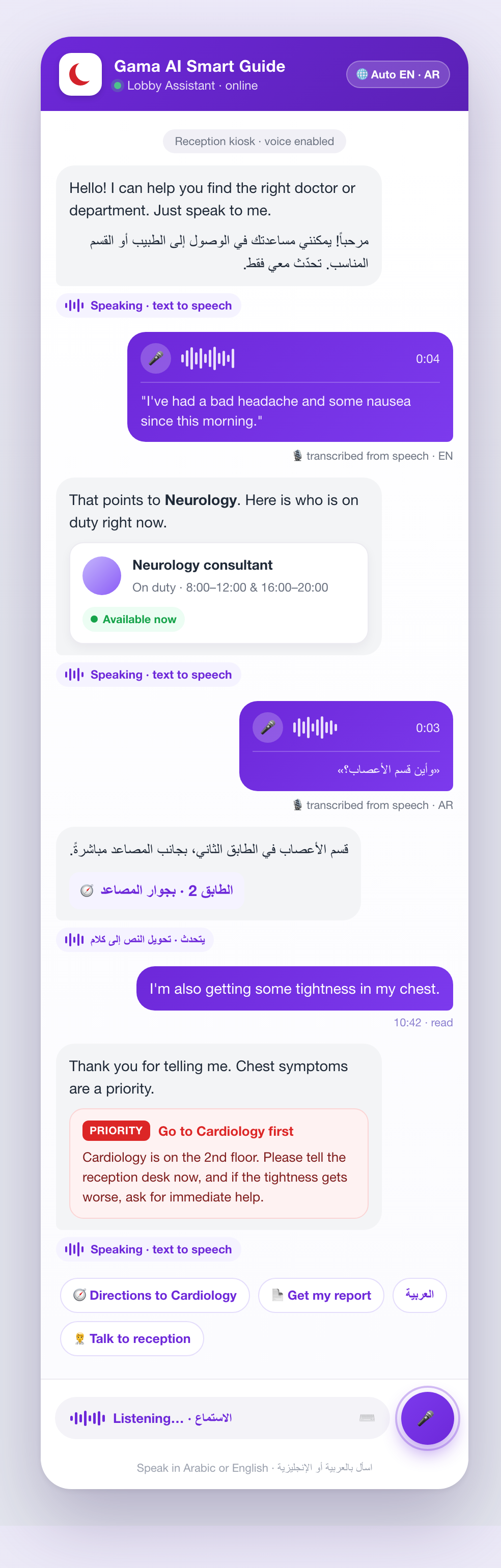
The agent recognizes a wide range of everyday complaints, from headache and nausea to back pain, knee pain, chest pain, stomach pain, fever, burns and infections, and routes each one to the correct specialty. When a symptom is severe, like chest pain, it points the patient straight to Cardiology first. When a patient needs a location, it gives the floor and the nearest landmark, in their language. Behind the scenes it is grounded in Gama Hospital's own knowledge: its doctors mapped to specialties, department and floor locations, clinic timings and services.
The difference it made
The clearest signal that the Gama AI Smart Guide is doing real work is when it does it.
Nearly half of all patient conversations happen after 6pm. That is the window when a hospital's front desk is at its lightest and its phone lines least likely to be answered, and it is exactly when patients lean on the agent most. The lobby now has coverage during the hours it used to have the least.
It closes the language gap on every shift. Because the agent speaks five languages, a patient's experience no longer depends on whether the receptionist on duty happens to share their language.
Patients hold real conversations, not one-shot lookups. On average, a patient asks more than three questions in a single visit: describe a symptom, get a department, then ask for the doctor's timing or the floor to walk to. They are being guided through a journey, which is exactly what the front desk could not always do.
Every answered question is one the front desk did not have to field. Symptom triage, doctor availability, medical-report questions and wayfinding are the four things patients ask the agent most, and each one resolved at the tablet is one fewer interruption at the desk and one fewer redirection to the wrong doctor.
There is a second, quieter payoff. Because every question flows through the agent, Gama Hospital now has a live read on what patients want the moment they walk in. Orthopedics is the single most-requested department, driven by back and knee pain. Neurology demand is led by headaches. Cardiology sees the most urgent cases. That is not just a support tool, it is a demand-sensing feed for how the hospital staffs its floors.
An opening move, not a one-off
The Smart Guide that Shafi championed is the first step in a much larger digital plan, and one that ladders directly into Saudi Arabia's national priorities. At the launch, Gama Hospital's Executive Director General set the ambition:
"The launch of this service represents the first step in an integrated digital project through which the hospital seeks to redesign the patient experience using artificial intelligence and smart analytics, in line with the goals of the national transformation and the Kingdom's Vision 2030 in the healthcare sector."
Mr. Riyad bin Hajji Al Mazrou, Executive Director General, Gama Hospital
Why this matters for other hospitals
Most hospitals think about AI as something that lives on their website or their WhatsApp line. Gama Hospital put it where the crowding actually happens: the physical lobby, on a tablet, with a voice, in the patient's language. The result is a front desk that is bigger than the desk. It works the late hours the humans cannot cover, speaks the languages a single receptionist cannot, and turns "I have a symptom" into "here is your doctor, here is the floor" without a single redirection.
For any hospital watching queues build in its lobby and lines light up on its phones, that is a model worth copying.
Want to see what a voice AI agent could do in your lobby, on your website, or on WhatsApp? Schedule a demo with Tars.
Ish is the co-founder at Tars. His day-to-day activities primarily involve making sure that the Tars tech team doesn’t burn the office to the ground. In the process, Ish has become the world champion at using a fire extinguisher and intends to participate in the World Fire Extinguisher championship next year.
- The busiest desk in the hospital
- About Gama Hospital
- The champion behind the project
- The solution: a voice AI agent that works the lobby
- The difference it made
- An opening move, not a one-off
- Why this matters for other hospitals


Build innovative AI Agents that deliver results
Get started for freeChosen by 800+ global brands across industries





Recommended Customer Success stories
How Rate My Therapist Doubled Visitor Engagement by Making an AI Agent Its Front Door

How The Avec Group Automated Their Symptom Checking With AI-powered Medical AI Agents